Reimagining a Traditional Taxi Driver App for In-Vehicle Software Integration

Overview
Traditional taxi driver apps were built as standalone hardware/software solutions, disconnected from modern vehicle operating systems and safety standards. Working closely with the CEO, sales, and engineering teams, I led the redesign of a legacy taxi driver app into a fully integrated in-vehicle software application – built to meet Android and Apple Auto Guidelines, reduce driver cognitive load, and support flexible passenger payment options.
The Problem
Through stakeholder interviews, heuristic evaluation, and user testing, I identified three core issues:
Non-compliance with Auto Guidelines – Over 90% of existing taxi apps failed to meet Android/Apple Auto standards, resulting in poor usability for drivers.
Cognitive overload and safety risk – Cluttered UI layouts packed too much content on-screen, violating the "at-a-glance" principle Auto Guidelines ie. The "at-a-glance" principle requires in-vehicle displays to convey essential information within a single glance (roughly 0.5–1 second), so drivers can return their attention safely to the road and ensures passenger safety.
Limited payment flexibility – Most apps supported only cash and card, falling short of rider expectations for split payments, vouchers, and Cabcharge – creating friction at the point of payment.
Research & Discovery
I combined three research methods to build a strong evidence base for the redesign:
Stakeholder interviews – to understand business requirements and surface pain points from drivers and taxi operators directly.
Heuristic evaluation – to benchmark the existing app against Android/Apple Auto Guidelines and usability best practices, identifying specific compliance gaps.
User testing – to validate real-world usability issues drivers experienced with the current app, particularly around safety and readability while driving.
The Solution
1. Defining requirements from research
I analysed and synthesised interview and testing data into a prioritised set of actionable feature improvements, forming the foundation for the new app's requirements.
2. Prototyping the proof of concept
I ran multiple rounds of UI iteration to design a first proof of concept (POC), focused on meeting Auto Guidelines' "at-a-glance" safety requirement while simplifying the driver's core tasks.
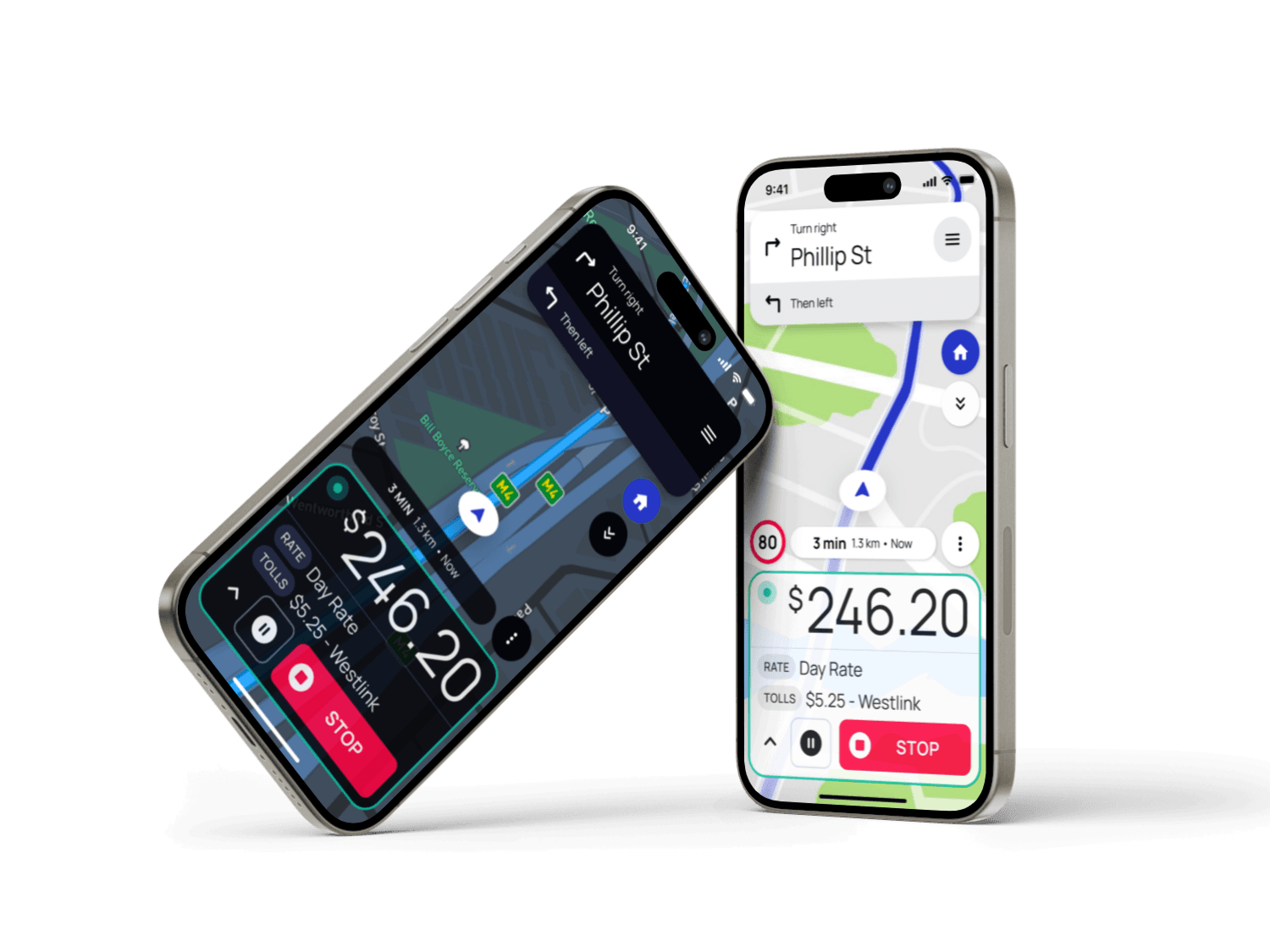
[Image: Taxi driver mobile meter screen in dark and light mode]
3. Validating with clients
I led design walkthroughs with external clients to gather feedback on the POC, then iterated the designs based on both internal and external input to finalise the design direction.
4. Preparing for release
I handed over final designs to front-end developers and conducted testing ahead of the app's first release, ensuring design intent translated accurately into build.
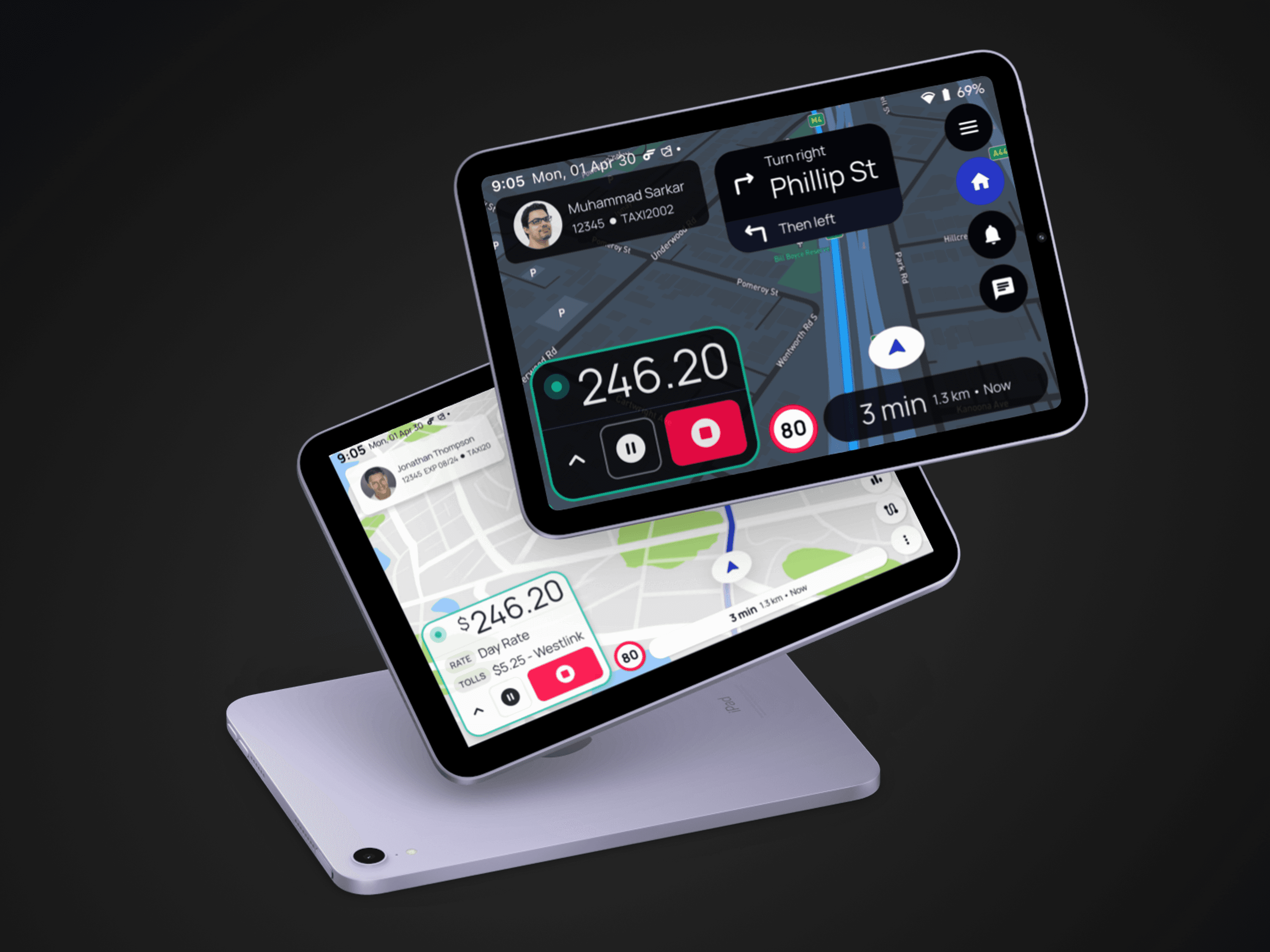
[Image: Taxi driver tablet meter screen in dark and light mode]
Results
The redesign delivered strong outcomes for drivers, passengers, and the business:
Auto Guideline compliance – The app meets Android and Apple Auto standards, ensuring all content is viewable "at-a-glance" (Auto Guidelines require all critical information to be understood within roughly 2 seconds, minimising driver distraction), to support driver and passenger safety.
Full in-vehicle integration – Built as a fully operational, integrated in-vehicle software app – a key differentiator that helped the business acquire new clients.
Driver satisfaction and task-completion time – Reduced average screen-glance time from 5 seconds to approximately 1 second
Reduced payment friction – Multiple payment methods now supported, creating a smoother fare experience for both drivers and passengers.


